Nestled against the foothills of the Aurès mountains, Biskra marks the transition between the fertile North and the great Saharan South. Capital of the Ziban, this network of oases has long been famous for the fertility of its palm groves and the mildness of its climate.
Nicknamed the “Queen of the Ziban”, Biskra embodies this perfect balance between greenery and desert, modernity and tradition. At once a cultural crossroads, a historic religious centre and a gateway to the Sahara, it offers a unique face of inland Algeria.
Practical information about Biskra
| Biskra — Practical information | |
|---|---|
| 📍 Location | At the foot of the Aurès mountains, capital of the Ziban, gateway to the Algerian Sahara. |
| ✈️ Access | Regular flights from Algiers, Constantine and Ouargla. By road, the city is easily reached from Batna (about 3h). |
| 📆 Best period | From October to April, with temperatures between 20 and 30°C. Summer can be very hot (up to 45°C). |
| 🌡️ Climate | Dry, bright and stable all year round. Winter nights remain cool and pleasant for walking. |
| 🏕️ Type of trip | Cultural tourism, thermal stays, oasis circuits, spiritual journeys and heritage discoveries. |
| 🎒 Tips | Bring light clothing, a hat and comfortable shoes for excursions in the ksour. Don’t miss tasting doubara, the emblematic dish of the Ziban. |
Discovery itinerary: 3 days in Biskra
- Day 1: arrival in Biskra, check-in and discovery of the town centre. Walk in Landon Park and the July 5th Garden, visit the medina and craft market. Late afternoon, a horse-drawn carriage ride and sunset from Fort Turc.
- Day 2: excursion to El Kantara and Dechra Hamra. Morning at the Roman bridge and the red gorges of El Kantara, lunch on site, then afternoon in Dechra Hamra to explore the old ksar, the lapidary museum and the seguias. Return to Biskra in the evening.
- Day 3: a spiritual and wellness day. Visit the Sidi Okba Mosque, discover the ancient manuscripts of Tolga, then relax at the Hammam Salihine thermal baths. Dinner with local specialities: chakhchoukha, mahjouba and date bradj.
A green oasis in the heart of the Algerian desert
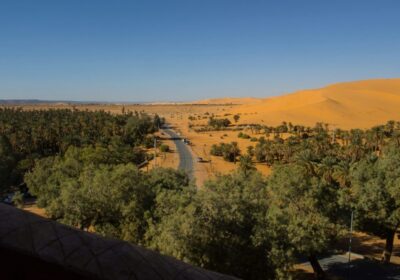
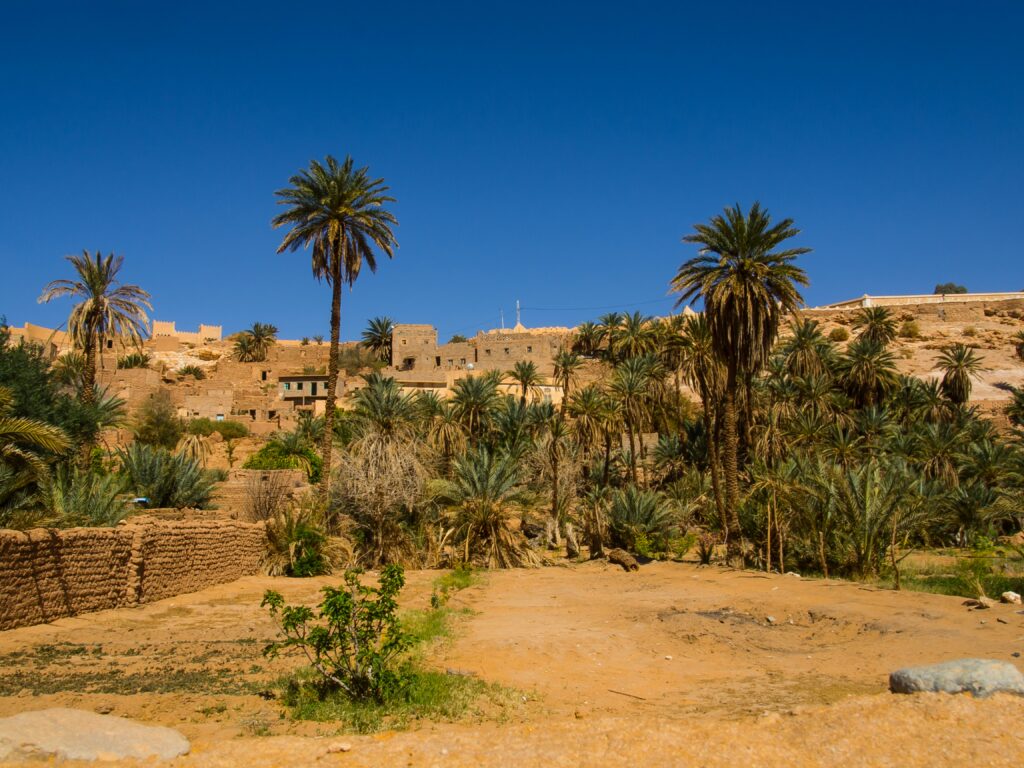
Biskra surprises with its contrast: instead of arid expanses, one finds immense palm groves, orchards and irrigated crops.
For centuries, its inhabitants have turned this land into a fertile garden through skilful water management and a determination to “bring the desert to life”.
The town blends old and new. In the medina, narrow streets house craftsmen, markets and ochre-coloured houses. Fort Turc dominates the plain, offering a view over the surrounding oases.
Green parks are the lungs of the city. Landon Park, one of the country’s finest, is home to more than fifty species of rare trees adapted to the Saharan climate. The July 5th Garden, created after the Battle of Zaâtcha (1849), symbolises Biskra’s rebirth after colonisation. These places are perfect for a stroll on foot or by horse-drawn carriage, typical of the region.
Unmissable sites around Biskra
1 — El Kantara, the gateway to the Aurès
About forty kilometres north of Biskra, El Kantara marks the natural border between the Aurès and the desert. Nicknamed “the Key to the Sahara”, this legendary oasis has inspired writers and painters for centuries.
Its Roman bridge, with a single arch 14 metres high, spans an impressive canyon of red rock. Restored in the 19th century, it remains a masterpiece of ancient engineering. Around it, the rocky landscape lights up at sunset, offering an unforgettable spectacle.
2 — Dechra Hamra, memory of the desert
Not far away, the village of Dechra Hamra, founded in 1048, bears witness to an ancestral way of life. The dwellings, built from clay, stone and palm trunks, illustrate the art of building with desert materials.
The lapidary museum, founded in 1929 by Gaston de Vulpillières, preserves precious carved stones and fragments of ancient architecture discovered in the region.
The ksar is organised around squares, a Koranic school, a meeting space for the elders and a network of seguias that irrigate the gardens. Amid palms, orange and lemon trees, oasis life flows peacefully.
Sidi Okba and Tolga: the spiritual heart of Biskra
1 — The Sidi Okba Mosque
Built in 686, the Sidi Okba Mosque is considered the oldest Islamic monument in the Maghreb. Built on the mausoleum of the conqueror Okba Ibn Nafi’, it combines stone, palm wood and lime in a simple yet majestic style.
Inside, visitors can admire wooden ceilings, hanging oil lamps and Ottoman-era tiles. The Kufic inscription decorating the dome, dated to the first century of the Hegira, is the oldest Islamic epigraphy in the country.
2 — Tolga and its manuscripts
Not far from Biskra, Tolga preserves an exceptional collection of around 1,500 ancient manuscripts covering several fields: Maliki fiqh, Koranic exegesis, philosophy, literature and medicine.
These treasures testify to Biskra’s great spiritual and intellectual influence over the centuries.
Hammam Salihine: wellness in Biskra
The thermal springs of Hammam Salihine, famous since Roman times, are a natural jewel of Biskra. Located a few kilometres from the town centre, the thermal complex offers a unique experience combining relaxation and treatment.
The sulphurous, chlorinated waters emerge at 43°C and are recommended for rheumatic, respiratory, gynaecological and dermatological conditions.
Thanks to its dry, sunny climate, Biskra is an ideal winter resort combining thermal treatments, walks through the palm groves and total rest.
Festivals and traditions of Biskra
1 — The great local celebrations
The people of Biskra keep alive a rich calendar of festivals and traditions. The oldest, Chayeb Achoura, is a religious celebration in which a zakat procession walks through the streets to the rhythm of flutes and tambourines, distributing gifts to families in an atmosphere of joy.
In spring, the renewal festival brings together folk groups, horsemen and musicians. The baroud dances, in which rifles mark the rhythm, recall the ancient warrior festivals of the Sahara.
Families prepare M’bardja, a date cake symbolic of the season.
2 — The date festival
In November, Biskra’s date festival celebrates the 4.5 million palm trees of the Ziban, which produce around 4 million quintals every year.
Exhibitions, markets and concerts liven up this both economic and cultural celebration.
Flavours and crafts of Biskra
1 — A generous, spiced cuisine
Biskra’s gastronomy is a journey in itself. Doubara, a spiced chickpea and broad bean soup with olive oil, is the region’s emblematic dish.
Also worth tasting are chakhchoukha, mahjouba (a pancake filled with tomato sauce), sviti (prepared in the mahress), as well as rustic dishes such as hasoua, tchicha frik, batout and m’touem.
2 — Crafts and traditional know-how
Biskra’s craftsmanship reflects the richness of Berber and Andalusian influences: wool weaving, traditional pottery, silver jewellery, basketry and objects made from palm.
Dates are also the base of many innovative products: molasses, vinegar, date coffee and even furniture made from palm trunks.
To conclude
Biskra, the “Queen of the Ziban”, is a mosaic of contrasts: a green city in the desert, a spiritual centre and historic crossroads, a place of wellness and living traditions.
Between the majesty of El Kantara, the serenity of Sidi Okba, the gentleness of Hammam Salihine and the richness of its festivals and local flavours, it offers a complete vision of inland Algeria — authentic and welcoming.
” Biskra is where the desert meets the garden, where history meets the spring, all within a single oasis. “
To discover Biskra and its oases in an immersive way, contact our team: your local partner for tailor-made cultural and Saharan tours.